
This is the fourth post in a series walking through the emotions of Parkinson’s disease — one at a time, honestly, from the heart. If you missed the earlier posts, you can find them here: Feeling Shocked, Feeling Afraid, and Feeling Sad. Whether you’re newly diagnosed, a long-time care partner, or somewhere in between, I hope something here finds you.
Growing up, I rarely saw Mom get angry.
Dad was the disciplinarian if one of us four kids stepped out of line. Mom felt anger, I’m sure — but she seldom showed it. Even when she caught me in a lie (her cardinal sin), she spoke sternly without raising her voice. She didn’t swear at me, at life, or at the TV.
After her Parkinson’s diagnosis, she hid how she felt even more. I was a teenager, and I think she wanted to protect me.
So the first time she swore in front of me, it stopped me cold.
We were trying to book a neurologist appointment. The earliest availability? A year away.
“That’s bullshit,” she said.
As swear words go, it’s mild. For Mom, it was huge. That one word was a crack in the surface — a sign that Parkinson’s was pushing her to her limits. She was coming out of a messy divorce. Her independence was slipping. So much was out of her control.
Who could blame her.
What Anger Looks Like in Parkinson’s
Parkinson’s can rob you of simple pleasures: sipping coffee, replying to an email, buttoning your jeans. It tests your patience at every turn. And when the source of your anger is something you can’t fix, the anger has nowhere to go.
So here’s your permission slip: if you need to scream “F you, Parkinson’s,” do it. Sometimes no other words will do.
In the early years of Mom’s diagnosis, weeks or months might pass with no visible anger. But when it came, it came hard. She would snap without warning at something that seemed trivial. Once, she threw her purse at my aunt. I think it surprised them both.
Looking back, I’m amazed she didn’t explode more.
For people living with Parkinson’s, anger can look like irritation with daily tasks, or grief over losing once-easy abilities. For care partners, it often comes from exhaustion, helplessness, or mourning the life you had envisioned.
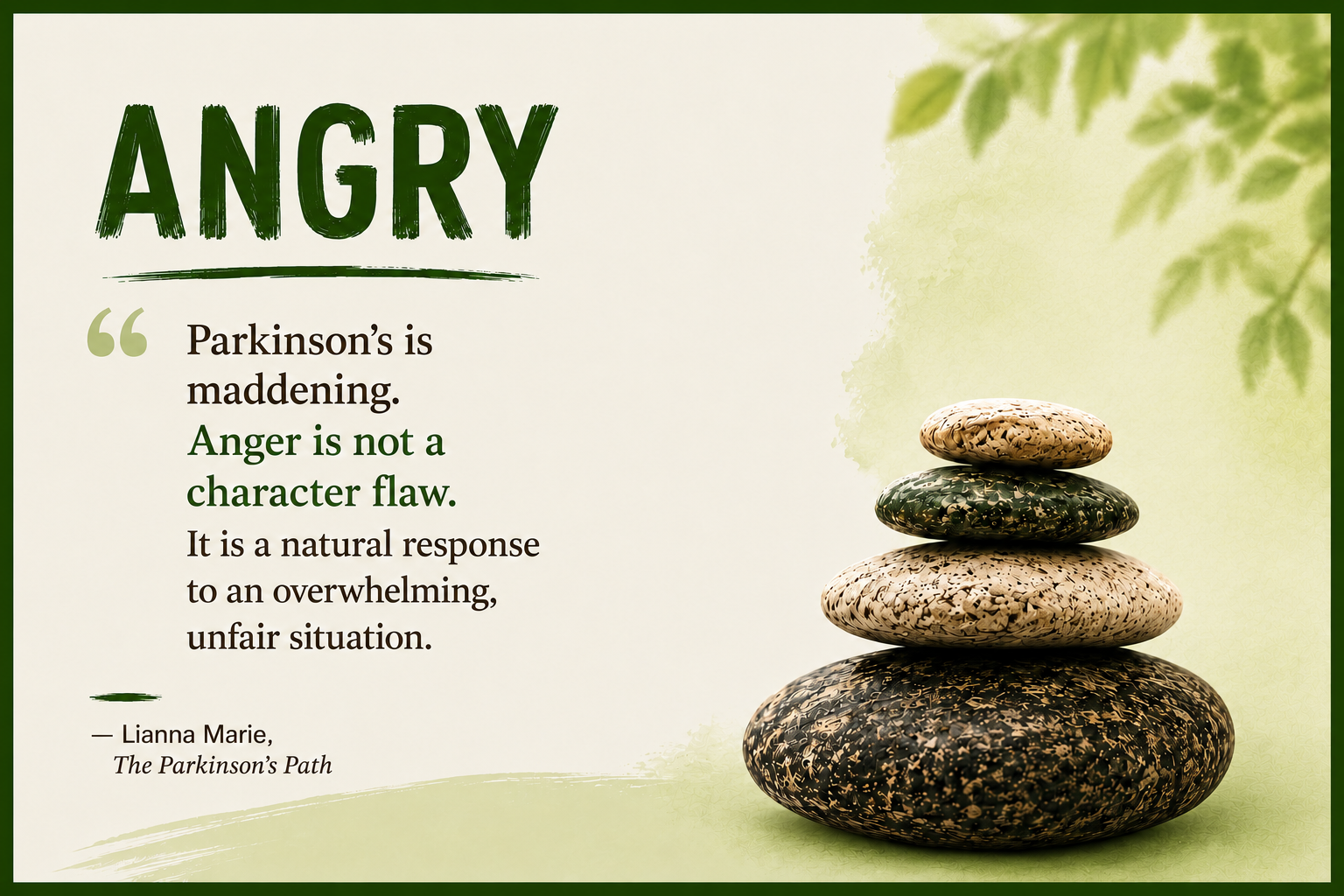
Sometimes anger simmers as quiet irritability. Sometimes it erupts. What matters is recognizing it for what it is: a natural response to an overwhelming, unfair situation. Anger is not a character flaw.
What You Can Do With It
Pushing anger down doesn’t make it disappear — it leaks out as tension, stress, or resentment. Anger needs movement. It needs somewhere to go.
A few things that actually help:
Anger can also be fuel. It can help you speak up, fight for better care, and advocate for change. Some of the most powerful voices in the Parkinson’s community started with anger — and turned it into something that helped other people.
Parkinson’s may take many things. But it doesn’t get to take your humanity. You are allowed to feel, to vent, to rage. When you acknowledge anger, you create space for something else: clarity, strength, and sometimes even peace.
Two Things That Help With Anger
Let it out on purpose. Anger needs movement — don’t bottle it up. Try a pillow yell, a brisk walk, or even a Rock Steady Boxing class if one is available near you. Physical movement turns heat into usable energy and gives your body somewhere to put what your mind is carrying.
Name what the anger is pointing to. Anger is usually pointing at something real — a boundary crossed, a need unmet, a loss unacknowledged. Try finishing this line: “I’m angry because ___. The next right step is ___.” You don’t have to fix it all at once. Just name it.
There are more Path Pointers for this emotion — including how to talk about anger before it strains a relationship, and how to begin practicing small self-forgiveness — in The Parkinson’s Path.
Words to Carry
“You are not the anger; you are the awareness behind the anger.” — Eckhart Tolle
When anger runs out of places to go, it can leave something quieter in its wake — loneliness. That’s what we’ll talk about next week.
In the meantime, if something here resonated, I’d love to hear from you in the comments. And if you know someone who needs to hear that their anger makes sense, please share this with them.
You don’t have to figure this out alone.
— Lianna 
Lianna Marie is the founder of All About Parkinson’s and the author of The Parkinson’s Path: Your Guide to Finding Hope, Happiness, and Meaning on Your Journey with Parkinson’s Disease, available on Amazon.