
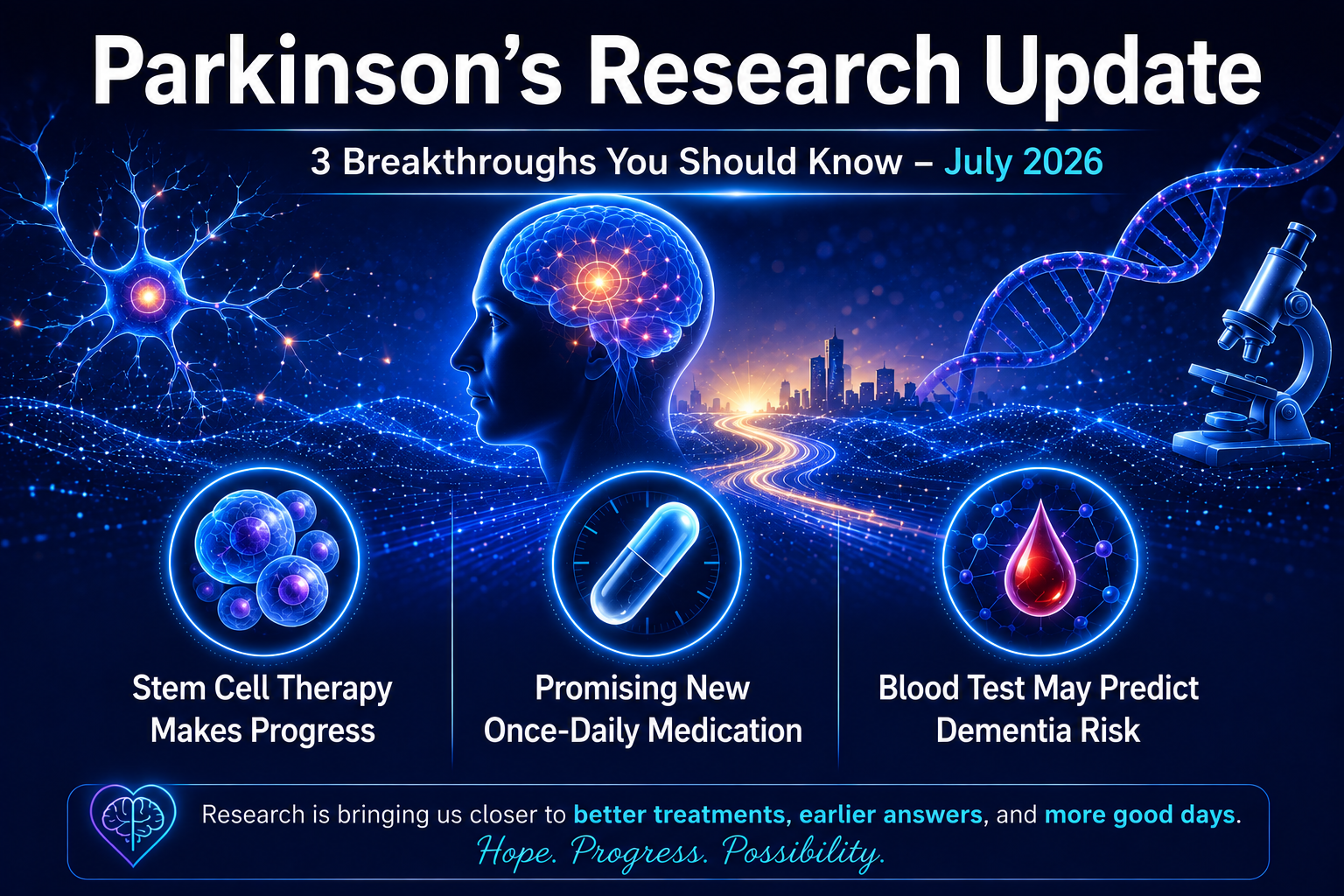
This July, researchers made encouraging progress in three important areas: stem cell therapy, a promising new once-daily medication, and a blood test that may one day help predict who is at greater risk of developing dementia.
Here’s what happened, why it matters, and what it could mean for you.
1. Stem Cells Were Put Into the Brain—and the First Results Are In
The goal: Put new dopamine-making cells back into your brain to replace what Parkinson’s destroyed.
In July, researchers in Sweden and the UK shared first-year results from a trial called STEM-PD.
Eight people with Parkinson’s got lab-made brain cells put into both sides of their brains. Seven finished the first year.
What happened:
– No unwanted movements
– Six out of seven people took less Parkinson’s medicine
Why this matters:
This isn’t a pill squeezing more from your leftover dopamine.
This is giving you new cells that make dopamine—which could mean better movement, fewer medication side effects, and relief that lasts because the cells keep working on their own.
What this means for you:
This was a small safety test, not proof the treatment works yet. Scientists need two more years to see if the cells survive.
But for the first time, lab-made brain cells were put into people with Parkinson’s without causing serious harm after one year and six out of seven people took less Parkinson’s medicine.
You can’t get this today. But it just moved from the lab toward real life.
2. A New Once-Daily Parkinson’s Pill Showed Strong Results
Levodopa is still the best medication for Parkinson’s movement problems.
But it’s not the only way to help your brain’s dopamine system work better.
In July, researchers shared full results for tavapadon—a new once-daily pill being tested for people with early Parkinson’s.
The study included 304 people diagnosed with Parkinson’s within the last three years. They took either tavapadon or a fake pill for about six months.
What happened:
– Movement and daily-function scores improved by 10.3 points with tavapadon
– The fake pill group improved by only 1.2 points
– 46% of people taking tavapadon said they felt “much improved” or “very much improved,” compared with 19% taking the fake pill
– Benefits started by week five and lasted through the study
Why this matters:
Parkinson’s medications don’t work the same for everyone.
A treatment that works through different dopamine receivers could give doctors another option—especially for people who want simpler once-daily dosing or don’t do well with current choices.
What this means for you:
Tavapadon doesn’t slow or reverse Parkinson’s. It manages symptoms.
It’s also not approved yet. Researchers still need more information about long-term safety and how it compares with medications already available.
But finishing a successful Phase 3 trial is a big step.
It means another potential Parkinson’s medication has moved much closer to becoming available to patients.
3. A Blood Test Could Help Predict Dementia Risk Years Earlier
One of the hardest questions families ask is:
Will Parkinson’s eventually affect thinking and memory?
Right now, doctors can’t answer that question for sure.
But researchers in Taiwan may have found a way to identify who faces a higher risk.
In July, they published a study following 123 people with Parkinson’s and 40 people without the disease for about five years.
The researchers measured proteins in the blood, including pTau217 and pTau231 — markers usually linked to Alzheimer’s disease.
What they found:
– Higher pTau217 levels at the start strongly predicted who later got dementia
– People above a certain pTau217 level had about 5.5 times the risk
– Those with the highest levels had even greater risk
– Higher pTau231 levels also predicted dementia
Why this matters:
Thinking and memory changes can be the scariest parts of Parkinson’s.
They can also seem to come out of nowhere.
A blood test that spots higher risk could help doctors and families watch changes more closely, plan earlier, and connect people with trials aimed at protecting thinking and memory.
It may also help researchers better understand how Alzheimer’s-related brain changes cause dementia in some people with Parkinson’s.
What this means for you:
This test can’t tell you for certain that you will—or won’t—get dementia.
It was a small study. The results need to be checked in larger and more diverse groups.
But one day, a simple blood test may replace some of the uncertainty with something families desperately need:
Time to prepare. Time to act. Time to make informed decisions.
What This All Means for You
July’s research moved Parkinson’s care forward in three different ways:
- Replacing the dopamine-making cells Parkinson’s destroys.
- Giving people a new once-daily medication option.
- Spotting dementia risk before major thinking and memory changes appear.
None of these is a cure.
But together, they show researchers doing more than just reacting to Parkinson’s after something has already gone wrong.
They’re asking:
- Can we rebuild what Parkinson’s has damaged?
- Can we give people better and easier treatment choices?
- Can we see difficult changes coming early enough to prepare?
That’s what progress looks like.
Not one dramatic cure arriving overnight—but scientists steadily replacing uncertainty with answers and hope with something real.