
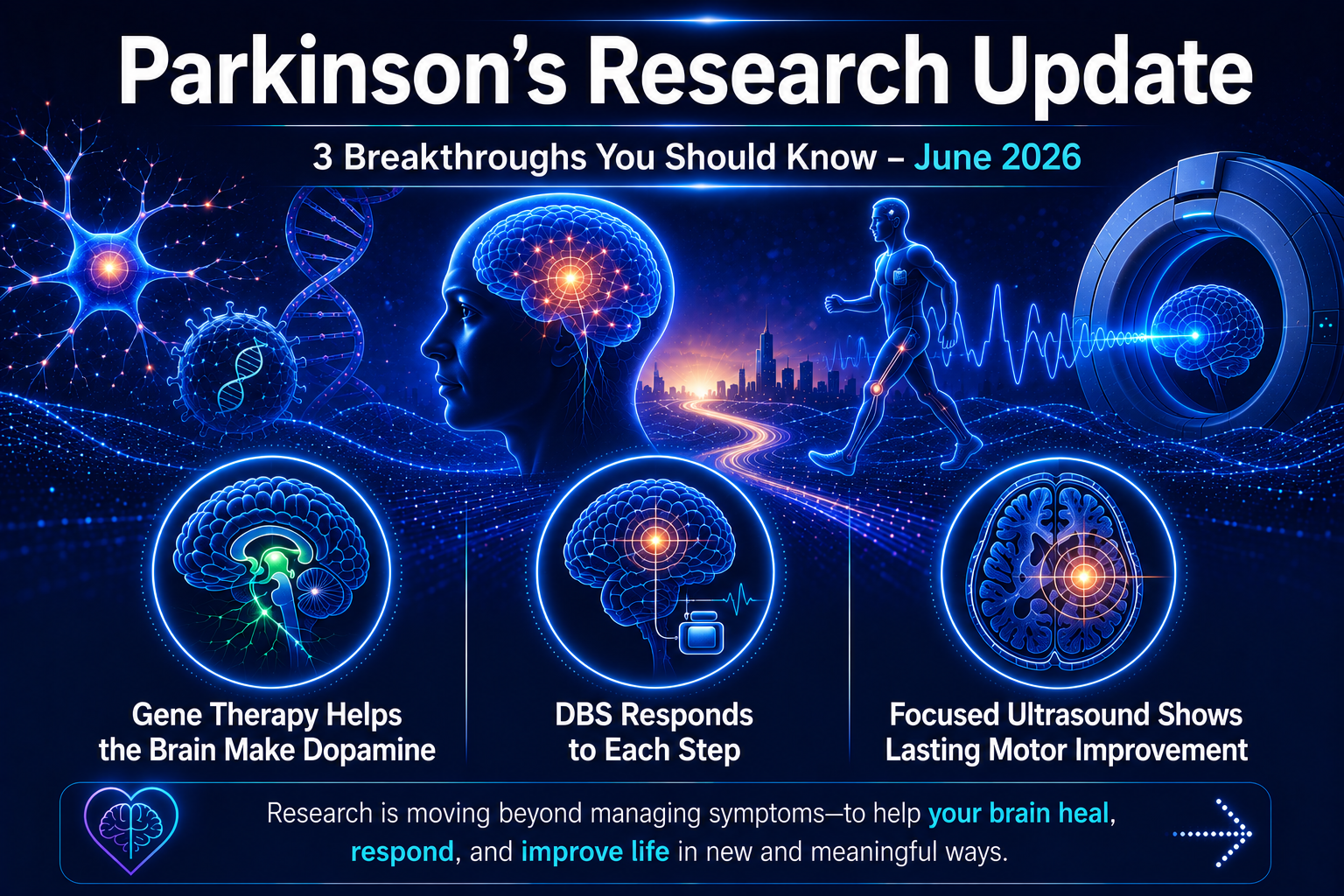
In this month’s update, we’re sharing three of the most important discoveries from June—what they are, why they matter, and what they could mean for you.
1. A Gene Therapy Helped the Brain Make Dopamine AgainThe dream of gene therapy for Parkinson’s is simple: Help your brain make more of the dopamine it’s missing. But doing that safely—and in a way that actually works inside the brain—has been really hard. In June, researchers shared results from an early trial of a new gene therapy called BBM-P002. This treatment puts two important dopamine-making tools directly into the putamen—a part of your brain that controls movement. The idea is to help your brain cells make dopamine on their own—not just rely on medicine to supply it. In the study, 10 people with moderate-to-advanced Parkinson’s got the treatment. What happened: – No serious side effects were reported Why this matters: This was a small, early safety trial—not proof that the treatment works yet. But it’s important because it shows this approach can be given to people with Parkinson’s and is safe over the first year. That matters because most Parkinson’s treatments still work from the outside in. This one is trying to change things from the inside. What this means for you: This is not available today. It still needs bigger trials to prove it works. But gene therapy is one of the most exciting areas in Parkinson’s research right now. Instead of just replacing what’s missing, it’s trying to teach your brain to make it again. That’s not managing Parkinson’s. That’s changing it. 2. Deep Brain Stimulation Started Responding to Each StepDBS can help with tremor, stiffness, and slowness. But walking problems are different. Freezing, falls, and balance issues are some of the hardest Parkinson’s symptoms to treat—and they can have a huge impact on your independence. In June, researchers at UCSF published a small trial testing a new kind of DBS made for walking. Instead of sending the same signal all the time, this system detected brain signals linked to each step and adjusted in real time. Think of it like a pacemaker for walking. Your body moves. Your brain signals change. The device responds. What happened: In a study of five people with Parkinson’s, this walking-based DBS was safe and reduced falls compared with regular stimulation. Why this matters: Standard DBS is powerful, but it’s not flexible. Parkinson’s symptoms change throughout the day. Walking changes from moment to moment. A system that can adjust as you move could make stimulation feel less like a fixed setting and more like a real-time partner. What this means for you: This is still very early. The study was small, and this technology is not ready for everyday use. But it points to where DBS may be heading. Not just stimulation that is turned on. Stimulation that listens. Adjusts. And responds to what your body is actually doing. 3. Focused Ultrasound Showed Lasting Help for Parkinson’s Motor ProblemsFor some people with Parkinson’s, the hardest part isn’t just tremor or stiffness. It’s the ups and downs. The OFF time. The dyskinesia. The unpredictable swings between moving well and not moving well. In June, results from a large trial showed that MR-guided focused ultrasound helped reduce motor problems in people with Parkinson’s. Focused ultrasound uses sound waves, guided by MRI, to target specific areas deep in the brain—without making a cut. In this study, 54 people were treated at nine centers in the United States, Spain, and Taiwan. What happened: – Motor problems improved by 66.8% three months after treatment Why this matters: Focused ultrasound is not a cure. It does not stop Parkinson’s from getting worse. But for people with advanced symptoms and medication-related problems, it may offer another treatment option—especially for those who are not good candidates for traditional brain surgery or do not want implanted hardware. What this means for you: This is not for everyone. It is still a brain procedure, the effects cannot be reversed, and side effects—especially speech and walking issues—need to be taken seriously. But the results are meaningful. They show that treatment without a cut may help reduce some of the motor problems that make daily life with Parkinson’s so challenging at times. What This All Means for YouFor decades, Parkinson’s research focused on one thing: managing your symptoms. These three June discoveries point to something different.
None of this is a cure. And none of it is ready for everyone today. But here’s what’s changing: Researchers aren’t just asking, “How do we cover up symptoms?” They’re asking:
That’s not managing Parkinson’s. That’s trying to change it—so you can move better, live more independently, and have more good days. |