
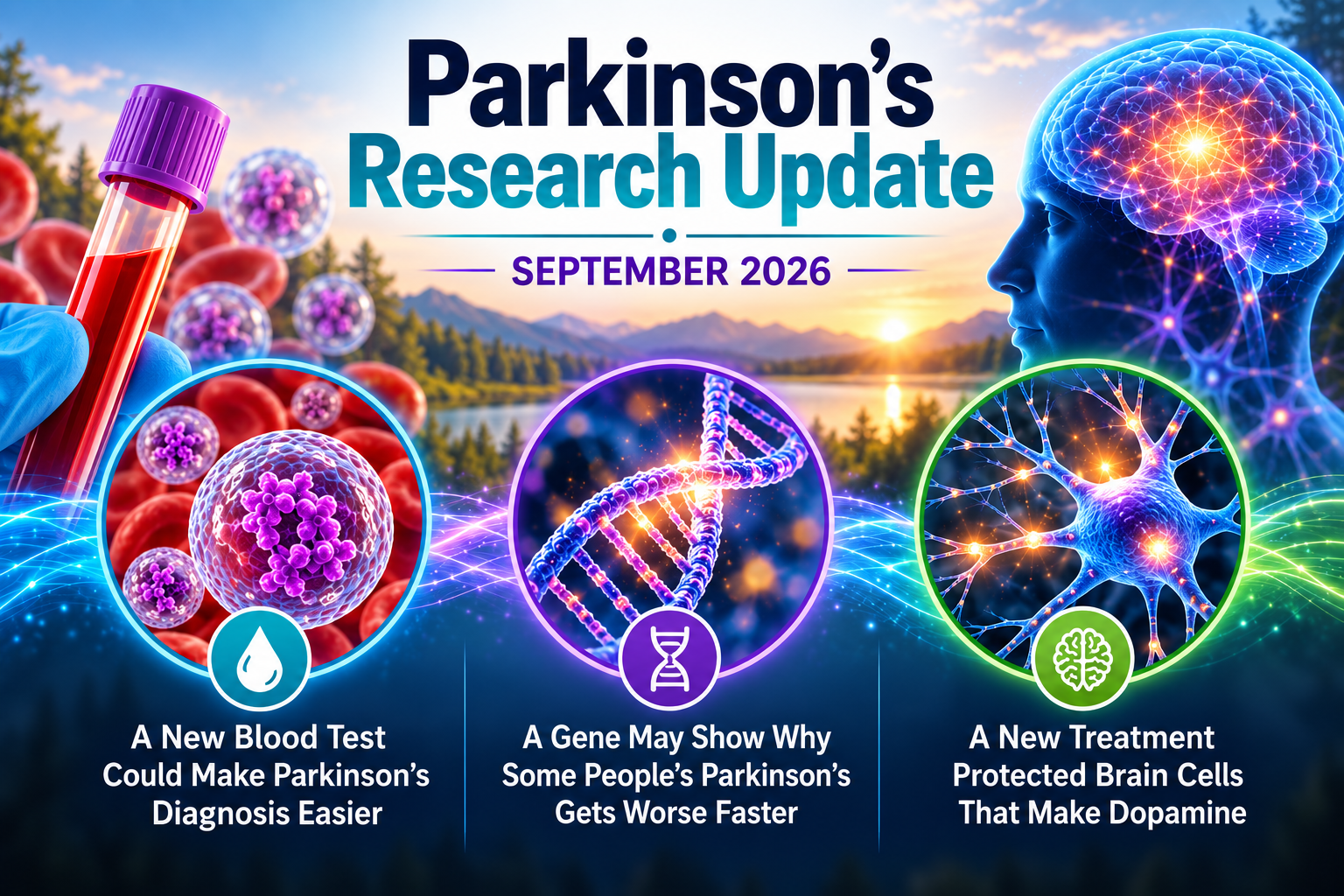
This September, Parkinson’s disease researchers made progress in three areas:
A blood test that could make diagnosing Parkinson’s easier.
A genetic clue that may show why some people’s Parkinson’s gets worse faster.
A new treatment being tested to protect brain cells that make dopamine.
Here’s what happened, why it matters, and what it means for you.
1. A New Blood Test Could Make Parkinson’s Diagnosis Easier
One of the biggest problems with Parkinson’s is that there’s no simple blood test that can tell you if you have it.
Diagnosis is mostly based on symptoms and a doctor’s exam.
Researchers in India may have found a solution.
They studied tiny packages in the blood called extracellular vesicles. Think of them as little boxes that carry proteins from one part of the body to another.
Inside those boxes, researchers found high levels of a protein called cofilin-1 in people with Parkinson’s.
What happened:
– Cofilin-1 levels were much higher in people with Parkinson’s
– The marker was very good at spotting Parkinson’s
– It also told Parkinson’s apart from PSP—another brain disease that looks similar
– Some of the tiny packages may have come from brain cells
The test scored 0.87 to 0.914 out of a perfect 1.0—strong early results.
Why this matters:
Parkinson’s symptoms can look like other brain conditions—especially early on.
That means uncertainty, more tests, and sometimes a changed diagnosis later.
A blood marker could give doctors another tool to help confirm what they see.
And because a blood test is easier than a spinal tap or brain scan, more people could get tested.
What this means for you:
You can’t get this blood test today.
It needs to be tested in more people first.
But it brings researchers closer to something families have wanted for years:
A diagnosis based on what’s in your blood—not just what a doctor can see.
2. A Gene May Show Why Some People’s Parkinson’s Gets Worse Faster
If you know people with Parkinson’s, you already know this:
Everyone is different.
One person may stay the same for many years. Another person may get worse fast.
In September, researchers found a gene that may help explain why.
The gene is called MC1R. This gene affects your skin and hair color.
But it also helps protect brain cells from damage.
Researchers watched 383 people with Parkinson’s for up to 12 years.
What happened:
– People with certain changes in the MC1R gene got worse 30% faster
– Researchers checked this again with different people
– In that group, people with MC1R changes got worse 50% faster
Why this matters:
Right now, researchers often test treatments on everyone with Parkinson’s the same way.
But if genes can show whose Parkinson’s will move faster, researchers can make better treatments for each person.
There’s more:
Doctors already have drugs that work on MC1R for other reasons. Early tests show these might protect brain cells.
That doesn’t mean the drugs work for Parkinson’s yet.
But it gives researchers a new idea to test.
3. A New Treatment Protected Brain Cells That Make Dopamine
Most Parkinson’s treatments today help with symptoms.
Researchers are also trying to find treatments that could protect brain cells before Parkinson’s damages them.
In September, researchers at the University of Pittsburgh tested a compound called 10-NO₂-OA.
The name is hard to say. The idea is easier.
The compound affects a protein called LRRK2.
When LRRK2 becomes too active, it can damage dopamine-making brain cells.
Researchers tested the compound in rats with Parkinson’s.
What happened:
– The treatment calmed down LRRK2
– It stopped brain cells from getting hurt
– It protected the part of the brain that helps you move
– The rats moved better
Why this matters:
LRRK2 has become one of the most important targets in Parkinson’s drug research.
What makes this research interesting is that it connects several things researchers believe cause Parkinson’s—genes, inflammation, cell damage, and the loss of dopamine brain cells.
Instead of just replacing dopamine after brain cells die, the goal would be to stop the damage before it happens.
What this means for you:
This study was done mostly in rats, not people.
A treatment that protects brain cells in rats can act very differently in people. Many promising compounds never make it to human trials.
So this is not a new Parkinson’s treatment—and we can’t say it slows the disease in humans.
What researchers found is a new way to target LRRK2 and protect dopamine brain cells.
Now they have to see if it works the same way in people.
What All This Means
September’s research moved forward in three ways:
- Finding proof of Parkinson’s in the blood.
- Understanding why Parkinson’s moves differently from person to another.
- Trying to protect brain cells instead of just treating symptoms.
None of this changes your treatment today.
But together, they show where research is going.
Researchers are asking:
Can we find Parkinson’s in your blood instead of just watching symptoms?
Can we understand why your Parkinson’s is different from someone else’s?
Can we protect brain cells early enough to stop damage?
Those are important questions.
Because the future may not be one treatment for everyone.
It may be earlier answers, care made just for you, and treatments aimed at what’s happening in your body.