
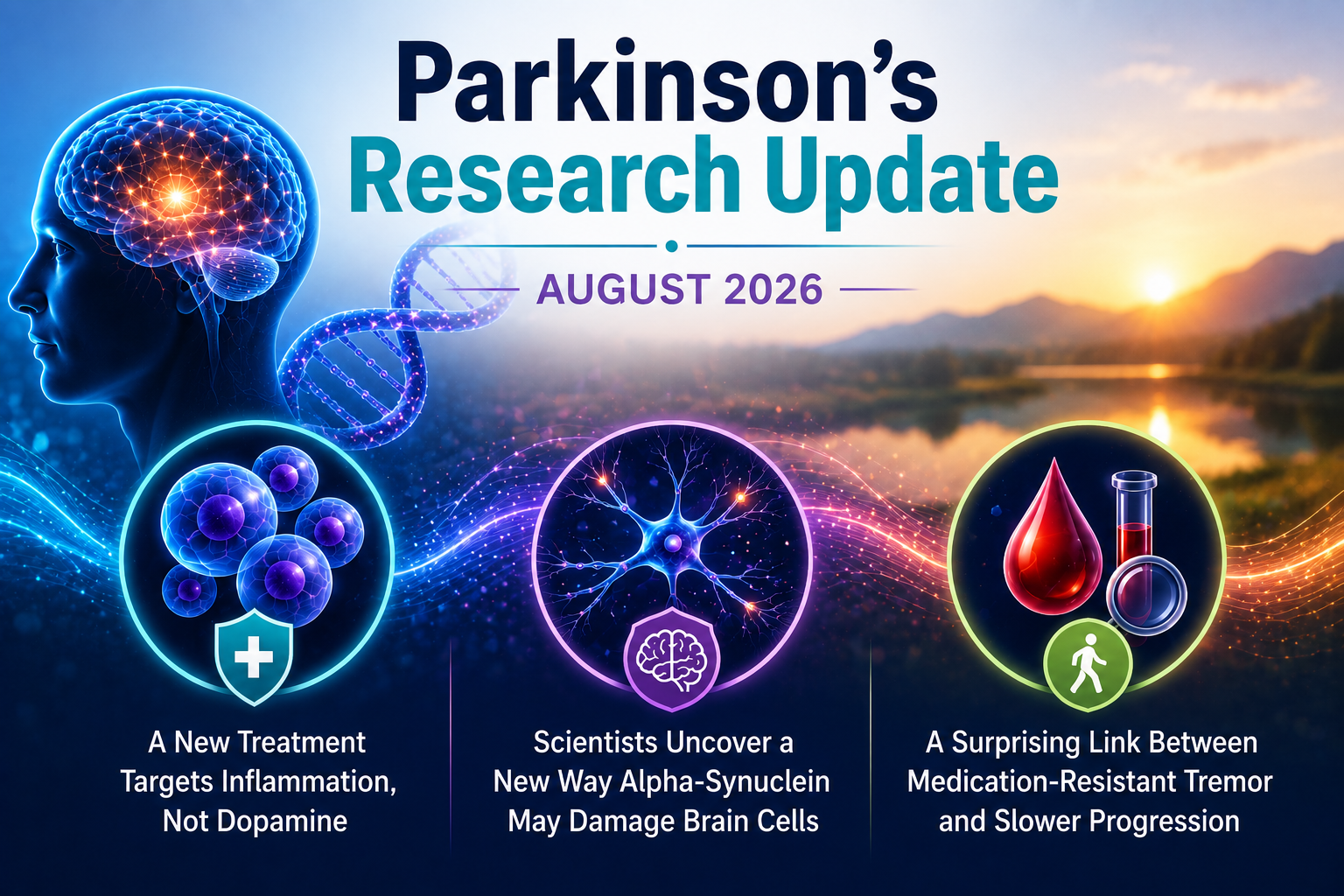
This August, researchers made progress in three very different areas: testing a treatment that targets inflammation rather than dopamine, uncovering a new way the Parkinson’s protein alpha-synuclein may damage brain cells, and finding a surprising connection between medication-resistant tremor and how quickly Parkinson’s progresses.
Here’s what happened, why it matters, and what it could mean for you.
1. A Different Kind of Parkinson’s Drug Just Showed Something We Haven’t Seen Before
For decades, every Parkinson’s medication has done basically the same thing: replace the dopamine your brain is losing, or help your brain squeeze more from what’s left.
Important? Absolutely.
But here’s what they don’t do: stop the damage that’s happening in the first place.
That’s why what happened in August matters.
A Drug That Works Differently
Researchers tested a new drug called bezisterim on 57 people with early Parkinson’s.
But bezisterim doesn’t touch dopamine at all.
Instead, it targets inflammation—the kind scientists increasingly believe may be fueling the brain cell damage in Parkinson’s.
For 12 weeks, half the group took bezisterim twice a day. The other half took a placebo.
Here’s What Happened
People taking bezisterim improved more than the placebo group in:
- Motor symptoms (movement)
- Daily activities (the things you actually need to do)
- Non-motor symptoms (sleep, mood, thinking)
But that’s not even the most interesting part.
Blood tests showed inflammation markers moving in the right direction.
And exploratory markers that track nerve cell injury—including something called neurofilament light—showed encouraging changes too.
The drug was well tolerated. No serious side effects.
Why This is Different
Your current medications manage symptoms after brain cells are already damaged.
This drug is testing a completely different idea:
What if we could reduce the inflammation that may be contributing to that damage in the first place?
Not just replacing what’s lost.
Actually targeting the biology driving Parkinson’s.
What This Means for You
This was a small study—57 people over 12 weeks.
The results came from the company developing the drug and haven’t been published in a medical journal yet.
So no, we can’t say this slows Parkinson’s progression. Not yet.
Larger, longer studies are coming next.
But here’s what you can take from this:
Scientists aren’t just making dopamine drugs better.
They’re going after Parkinson’s in a fundamentally new way.
And for the first time, we’re seeing early evidence that targeting inflammation might actually work.
That’s not just hope.
That’s a different path forward.
2. Scientists Just Discovered How Parkinson’s Actually Damages Your Brain Cells
We’ve known for years that a protein called alpha-synuclein clumps up in the brains of people with Parkinson’s.
Those clumps—called Lewy bodies—are basically the signature of the disease.
But here’s what we haven’t known:
How do those clumps actually affect brain cells?
In August, researchers at Oxford found the answer. Or at least a major part of it.
And it changes how we think about stopping Parkinson’s.
The Discovery
Using human brain cells grown in the lab—plus brain tissue from people who had Parkinson’s—scientists watched exactly what the abnormal protein does.
Here’s what they saw:
The alpha-synuclein was blocking a tiny doorway inside your cells.
Think of it like this: Your cells are like houses. Proteins need to move through doorways to get where they’re going—to be processed, packaged, and shipped out.
The abnormal protein was jamming that doorway shut.
When that doorway gets blocked:
- Important proteins can’t get through
- Your cell’s garbage disposal system stops working properly
- Waste builds up inside the cell
- The cell releases even MORE of the damaging protein
The protein damages the cell. The damaged cell makes more bad protein. Repeat.
But Here’s the Hopeful Part
When researchers reduced the abnormal protein—or helped cells break it down faster—some of the damage reversed.
The doorway started working again.
The cell’s cleanup system improved.
Why This Changes Everything
Right now, your Parkinson’s medications help after brain cells are already damaged or dying.
But if scientists know exactly HOW alpha-synuclein damages cells, they can design treatments that interrupt that process.
Not after the damage.
During it.
Or even before it starts.
Instead of waiting until dopamine cells are gone, a future treatment might stop them from dying in the first place.
What This Means for You
This research happened in lab-grown cells and donated brain tissue—not in people yet.
So there’s no new pill from this discovery today.
But this is exactly how breakthroughs start.
First, you understand what’s going wrong. Then, you figure out how to stop it.
For decades, we’ve known alpha-synuclein was the problem.
Now we’re finally seeing how it actually does the damage.
And once you know how something breaks, you can figure out how to fix it.
That’s not someday hope.
That’s the path to treatments that could actually change Parkinson’s—not just manage it.
3. The Tremor That Won’t Quit Might Actually Be Good News
Here’s something that sounds completely backwards:
What if the tremor that doesn’t respond to your medication is actually a sign your Parkinson’s might progress more slowly?
Researchers in Beijing just found exactly that.
And it flips our assumptions upside down.
What They Discovered
Scientists looked at nearly 500 people with Parkinson’s and divided them into three groups:
- People whose resting tremor responded to medication
- People whose tremor stayed stubborn—didn’t respond to meds
- People who didn’t have resting tremor at all
Then they tracked everyone over time.
Here’s What Happened
The people with medication-resistant tremor had something unexpected:
Their other Parkinson’s symptoms—the non-tremor stuff—progressed more slowly than everyone else.
Slower than people whose tremor responded well to medication.
Slower than people without tremor.
And when researchers looked at brain scans, the difference wasn’t just about dopamine loss.
Something else was going on.
Why This Matters
Parkinson’s has never been one disease.
Two people get the same diagnosis. One person’s tremor responds beautifully to medication. The other’s doesn’t budge.
One person progresses quickly. Another stays stable for years.
We’ve always known Parkinson’s behaves differently in different people.
This study shows us why: different symptoms may mean different biology underneath.
And if doctors can identify those patterns, they might eventually predict how your Parkinson’s will progress—and treat it accordingly.
What This Means for You
If your tremor doesn’t respond to medication, this doesn’t mean you’re protected from Parkinson’s.
And you absolutely can’t predict your future based on this one study.
It was observational research that needs to be confirmed in other groups.
But here’s what you can take from this:
A symptom that’s harder to treat doesn’t automatically mean your disease is worse or moving faster.
In fact, it might mean the opposite.
For years, people with Parkinson’s have been asking the same question:
“What will MY Parkinson’s look like?”
Studies like this are the first steps toward answering that question.
Not with guesses.
With science that recognizes your Parkinson’s isn’t like everyone else’s.
And that’s how we get to treatments designed for you—not just for “Parkinson’s” in general.
What All This Really Means
Three breakthroughs in one month.
Three completely different ways to fight Parkinson’s.
A drug targeting inflammation—not just dopamine.
The discovery of how the damaging protein may damage brain cells.
Proof that stubborn symptoms don’t mean faster disease.
None of this changes your treatment tomorrow.
But here’s what’s different:
Scientists have stopped treating Parkinson’s like one simple dopamine problem.
They’re finally asking the right questions:
What’s causing the damage?
Can we stop it before cells die?
Why does everyone’s Parkinson’s look different?
Those are exactly the questions we need answered if we’re going to move from treating Parkinson’s symptoms to truly changing the course of the disease.