
This is the first post in a series walking through the emotions of Parkinson’s disease — one at a time, honestly, from the heart. Whether you’re newly diagnosed, a long-time care partner, or somewhere in between, I hope something here lands for you.
Mom’s left pinky started to wiggle on its own. The rest of her sat perfectly still.
She knew it wasn’t nothing. But every time she brought it up, her doctor waved it off as “stress.” She tried to believe him. Her gut wouldn’t let her.
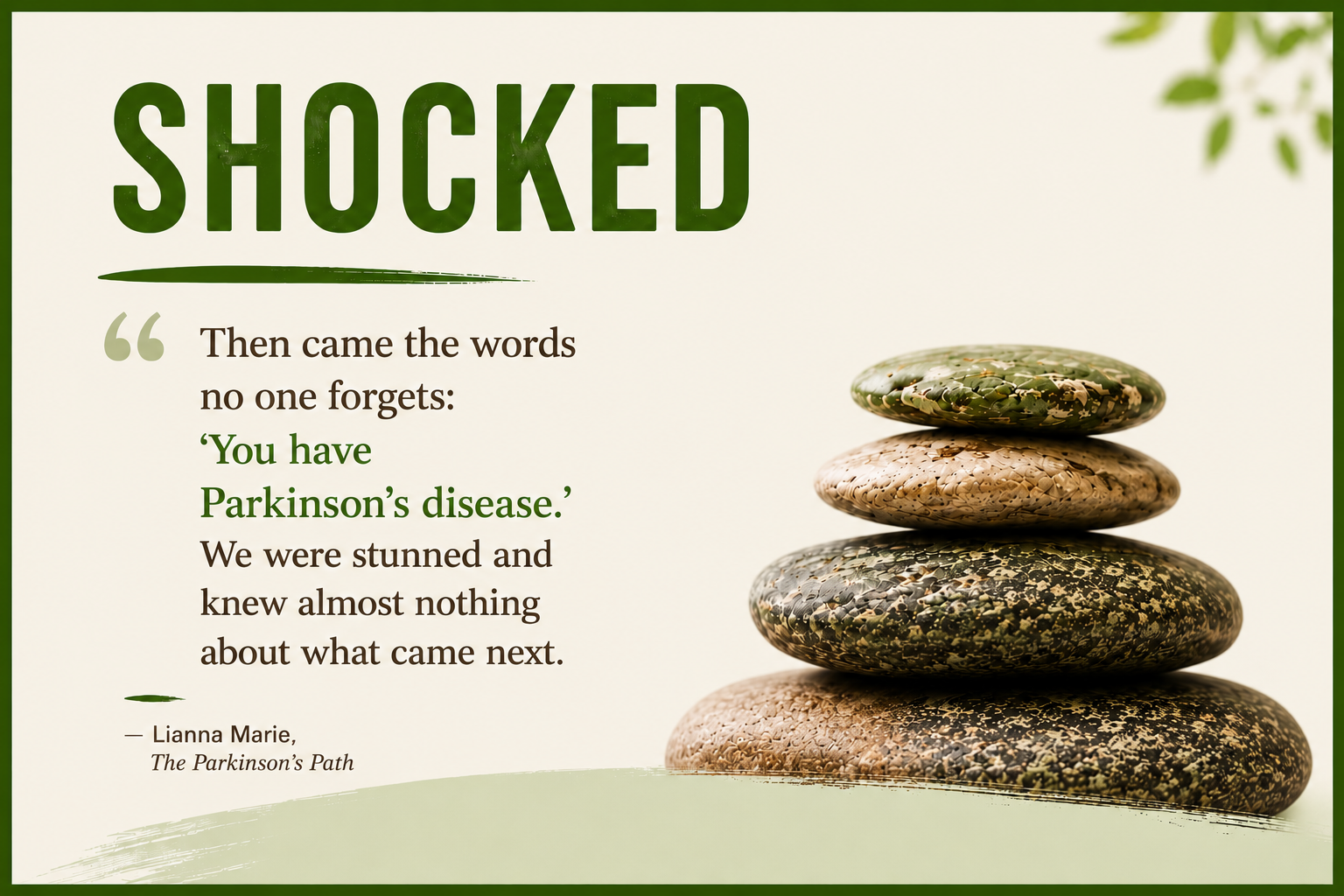
After three years of pushing for answers, she finally got a referral to a neurologist. Then came the words no one forgets: “You have Parkinson’s disease.”
She was in her forties. In the early nineties, most people pictured Parkinson’s as an older man’s disease. Mom wasn’t the first woman or the first person under fifty to be diagnosed — but it sure felt that way in her world. Even her doctor seemed stunned.
The rest of us were stunned, too. I was a teenager and hadn’t noticed her pinky until she pointed it out. We knew almost nothing about Parkinson’s. The only person we could name who had it was Muhammad Ali, and somehow knowing a legend was in the same boat made it feel a tiny bit less terrifying. Mostly, though, we were in the dark.
Shock Looks Different for Everyone
Here’s what I’ve learned after thirty years in the Parkinson’s community: there is no single way to be shocked.
Some people aren’t surprised when they’re diagnosed. They’ve suspected it for a while and started quietly bracing. Others are completely blindsided, having chalked symptoms up to stress or aging for years. Either way, hearing “You have Parkinson’s disease” is heavy. It takes time to absorb.
Shock can look like denial. It can look like numbness, or hypervigilance, or diving headfirst into research at midnight. It can look like my mom — who was in the middle of a messy divorce at the time of her diagnosis and, in her own words, “didn’t have time for Parkinson’s.”
Illnesses don’t wait for a convenient moment. We play the hand we’ve got.
Sometimes shock also carries a surprising passenger: relief. A name for something that has been nameless. An explanation for what the body has been doing. Mom told me early on, “I’ve got the good kind of Parkinson’s” — her neurologist had mentioned that a resting tremor can sometimes mean a slower progression. She held on to that. We all did.
And sometimes shock takes months — or even years — to fully settle. Our emotions don’t always catch up with the facts on the same timeline.
If You’re Here Right Now
Whether you’re shaken, foggy, angry, or oddly calm — you’re not doing it wrong. Your response is human.
I’ll share something I don’t often say publicly: even now, after everything, I sometimes catch myself watching my own left hand. With Parkinson’s on both sides of my family and all the reading I do, it’s hard not to wonder. If I sit in that fear too long, it takes over. So I don’t.
That’s not denial. That’s a choice about where to put my energy.
You’ll find your version of that, too. Not all at once — but one step at a time.
Two Things That Helped Us in the Shock Phase
Take a breath on purpose. A life-changing diagnosis can freeze you. Before anything else, pause. Try two rounds of box breathing: inhale for 4 counts, hold for 4, exhale for 4, hold for 4. It sounds small. It isn’t.
Be gentle with yourself. If you can’t name what you’re feeling yet, try swapping one script: trade “I should be handling this better” for “I’m doing the best I can today.” Compassion beats criticism every time.
There are more Path Pointers for this emotion — along with practical scripts, book recommendations, and step-by-step tools — in The Parkinson’s Path.
Words to Carry
“You don’t have to control your thoughts. You just have to stop letting them control you.”
— Dan Millman
Shock fades. It always does. What comes next — for many people — is fear. Fear about what this means, what the future holds, and what changes are coming.
That’s what we’ll talk about next week.
In the meantime, if something here resonated, I’d love to hear from you. And if you know someone who has just received a Parkinson’s diagnosis — for themselves or someone they love — feel free to share this with them.
You don’t have to figure this out alone. That’s what this community is for.
— Lianna 
Lianna Marie is the founder of All About Parkinson’s and the author of The Parkinson’s Path: Your Guide to Finding Hope, Happiness, and Meaning on Your Journey with Parkinson’s Disease, available on Amazon.