
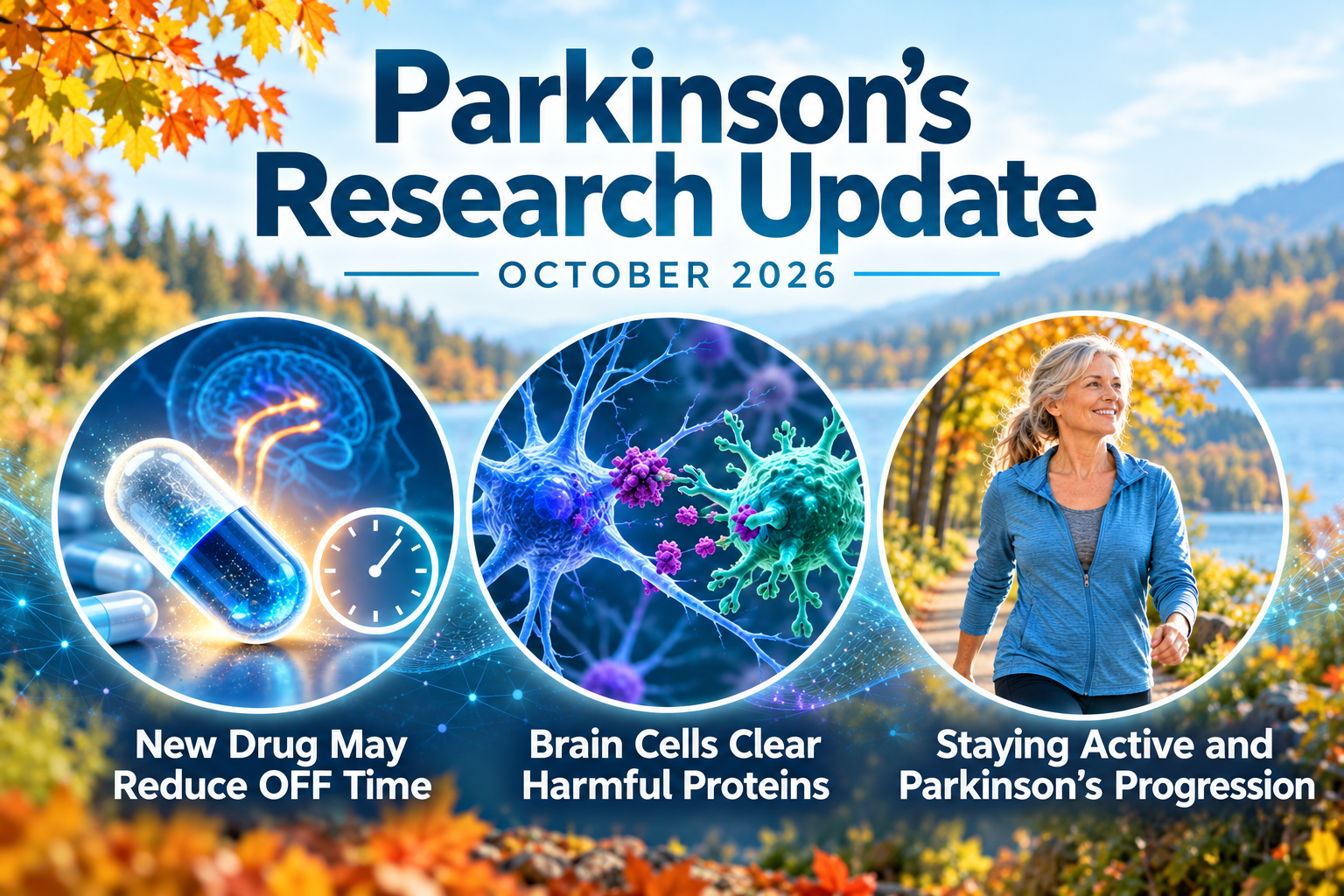
This October, Parkinson’s disease researchers made progress in three areas:
- A promising new drug that could help reduce unpredictable OFF time.
- A surprising discovery about how the brain’s own cells help clear harmful Parkinson’s proteins.
- A seven-year study linking physical activity with slower changes in movement, memory, and thinking.
Here’s what happened, why it matters, and what it means for you.
1. A New Parkinson’s Drug May Help With “OFF” Time
Many people with Parkinson’s have the same problem. Their medicine works for a while. Then it stops working, and they don’t know when it will happen.
One minute you feel fine. The next minute, your shaking, stiffness, or slowness comes back.
This is called OFF time.
In October, researchers shared good news about a new drug called solengepras. It was tested in a large study. This is the last big step of testing before a drug can be approved.
How is this drug different?
Most Parkinson’s drugs work by adding to or acting like dopamine, a brain chemical that helps you move.
Solengepras works in a different way. It works on a part of the brain that slows movement down.
Think of it like letting off the brakes, so your body can move more easily.
What did the study find?
The study had 341 people with Parkinson’s. Their regular medicine was not fully controlling their symptoms.
For 12 weeks, some people took solengepras. Others took a fake pill, called a placebo. Everyone kept taking their regular Parkinson’s medicine.
Here’s what happened:
– People who took the higher dose had about 37 fewer minutes of OFF time each day than people who took the fake pill.
– They also had more good movement time without extra movements they couldn’t control.
– Some people found daily tasks a little easier and felt less sleepy during the day.
– Most people handled the drug well. Most side effects were mild or not too bad.
Why does this matter?
Levodopa is still the best medicine for Parkinson’s movement problems.
But over time, it can stop working as smoothly. People may need to take it more often. Taking more can sometimes cause extra twisting or jerking movements. Doctors call this dyskinesia.
Solengepras doesn’t work through dopamine. So researchers hope it can help people move better without causing as many of these extra movements.
What does this mean for you?
You can’t get solengepras yet, but someday, it may give doctors one more way to help people with their symptoms. If you have OFF times you can’t predict, even a little more good time each day could make a real difference.
2. Scientists Found Brain Cells That Can Help Clean Up Harmful Parkinson’s Proteins
One of the biggest questions about Parkinson’s is why some brain cells get damaged and die.
We know a protein called alpha-synuclein can stick together in clumps inside brain cells. These clumps are closely tied to Parkinson’s.
But scientists just learned something new. Your brain may already have a way to help get rid of these clumps.
In October, researchers at the University of Oxford in England shared a new study. They found that some cells in the brain can remove the harmful protein from other brain cells.
These helper cells are called microglia. They are part of the body’s defense system.
Think of them as the brain’s cleanup crew.
What did the study find?
The researchers grew human brain cells in a lab. Then they watched what happened when the harmful protein built up inside the brain cells that make dopamine. Dopamine is a brain chemical that helps you move.
Here’s what they saw:
– Some of the cleanup cells could tell which brain cells had the harmful protein.
– The cleanup cells took away small pieces of those brain cells that held the clumps.
– This lowered the amount of harmful protein without killing the whole brain cell.
– The researchers found a protein called GPNMB that helped the cleanup cells do this job.
Why does this matter?
For years, scientists have tried to stop this harmful protein from building up in the brain. Many new treatments being tested try to stop the clumps from forming.
This study points to another idea. What if scientists could help the brain get better at cleaning up the harmful protein on its own?
Instead of adding something new, future treatments might help the brain protect itself.
What does this mean for you?
Learning how the brain protects itself could someday help scientists make treatments that do more than ease symptoms. They might help keep brain cells from getting damaged in the first place.
3. Staying Active Was Linked to Slower Parkinson’s Changes Over Seven Years
You’ve probably heard it many times: exercise is good for people with Parkinson’s.
But could staying active also be tied to how fast Parkinson’s symptoms change?
A new study shared in October says it might.
Researchers from the University of Cincinnati and other schools followed 294 people with mild to medium Parkinson’s. They followed them for up to seven years.
They looked at how much people moved each week. That included walking, swimming, gardening, housework, and harder exercise too.
They also kept track of changes in movement, memory, and thinking.
What did the study find?
Here’s what they saw:
– People who were more active tended to have slower changes in memory and thinking.
– Their movement problems also got worse more slowly.
– People who were active for more than eight hours a week showed almost no drop, on average, on one memory and thinking test.
– The link showed up in different ways of measuring activity, like how much time people were active and how hard they worked.
Why does this matter?
Most Parkinson’s treatments use medicine or surgery to help with symptoms.
But being active is something many people can add to their everyday lives.
The best part of this study is that it wasn’t just about movement. It was also about memory and thinking.
Changes in memory and thinking can be some of the hardest parts of Parkinson’s. They are hard for the person with Parkinson’s, and for the people who care for them.
Finding ways to keep the brain healthy over time really matters.
What does this mean for you?
This study found a link between staying active and slower changes in Parkinson’s. But it doesn’t prove that exercise itself slowed the disease.
Still, the findings add to growing evidence that staying active may be good for both your body and your brain.
If you have Parkinson’s, talk with your doctor or care team about activities that are safe and doable for you.
Walking, swimming, biking, dancing, or working with a physical therapist may all be good choices, depending on what you can do.
What matters most is finding a way to keep moving that works for you.
What All This Means
This month’s research moved things forward in three very different ways:
1. A new drug that may help people move better without working through dopamine.
2. A look at how the brain’s own cleanup cells may help get rid of harmful proteins.
3. A study on how staying active is linked to movement and thinking over time.
None of these is a cure.
But together, they show where research is going, and that’s good news.
Scientists are asking:
Can we give people more good hours each day?
Can we help the brain protect itself?
Can everyday activities help keep the body and brain healthy over time?
These are important questions.
Making life better with Parkinson’s isn’t only about finding a cure. It’s also about helping people move better, stay on their own longer, and have more good days.
That’s progress worth watching.