
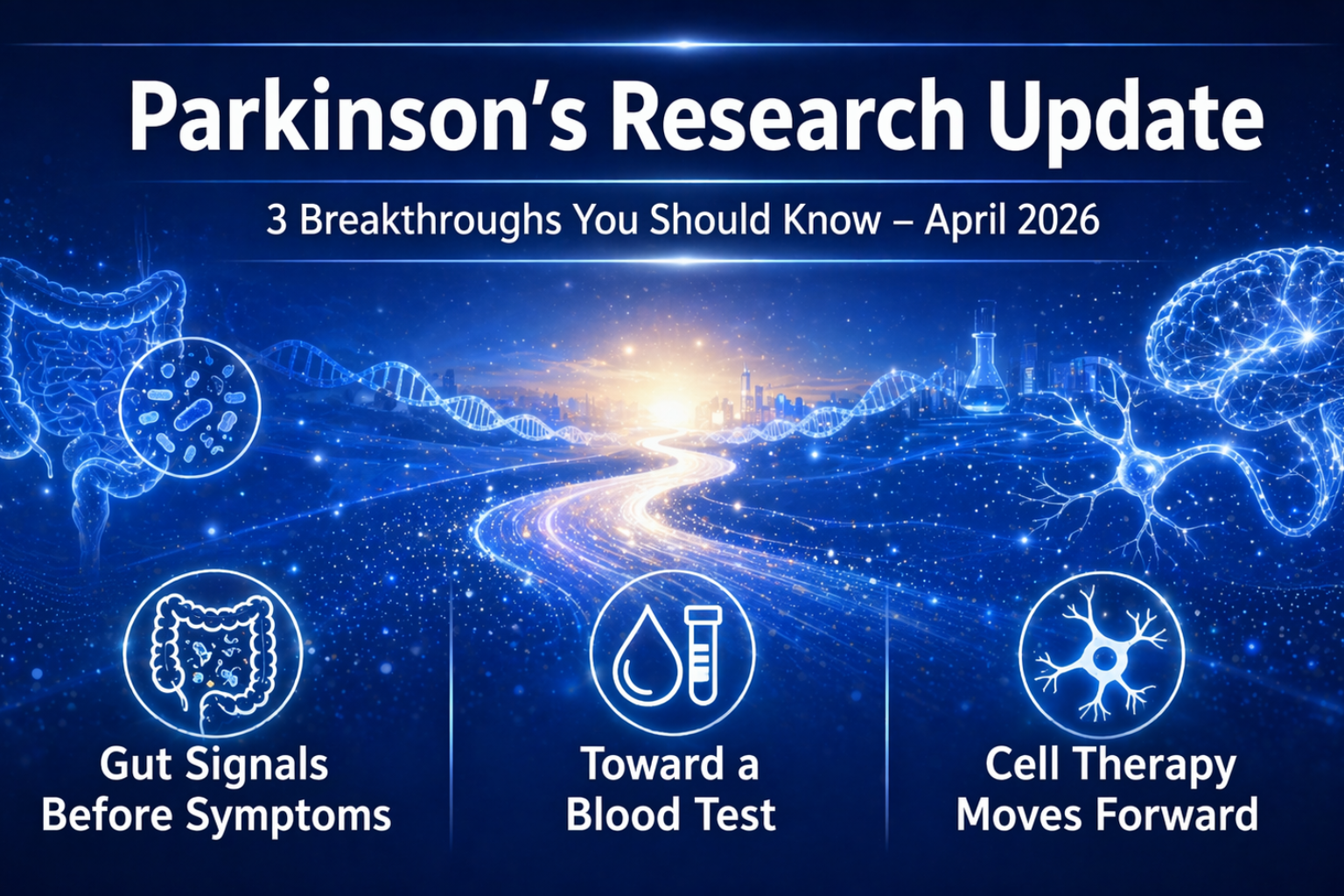
April brought progress on three fronts that could help reshape the future of Parkinson’s care: earlier risk detection, more accurate diagnosis, and advancing cell-replacement therapy into the real world.
In this month’s update, we’re breaking down three of the most important developments from April—what they are, why they matter, and what they could mean for you.
1. Your Gut Bacteria Might Show Parkinson’s Risk Years Before Symptoms Start
In April 2026, scientists published a study showing that gut bacteria changes might predict Parkinson’s disease before you have any symptoms.
They studied gut bacteria in people with Parkinson’s, people with a high-risk gene variant (but no disease), and healthy people.
What they found:
People with the risky gene—who felt completely fine—had gut bacteria that looked partway between healthy people and Parkinson’s patients.
Even 20% of healthy people without the gene showed similar changes.
Why this matters:
Doctors can only diagnose Parkinson’s after movement problems start. By then, you’ve lost over half your brain cells that make dopamine.
Your gut bacteria might be changing years earlier—giving a heads-up before damage happens.
What this means for you:
This isn’t available at your doctor’s office yet.
But it shows we might someday catch Parkinson’s risk early with a simple stool test—not waiting for tremors or stiffness.
Catching it early means you could start treatment before your brain takes major damage.
For the first time, your gut might tell you what’s coming for your brain.
2. A Simple Blood Test Might Soon Diagnose Parkinson’s
On April 22, researchers published a study showing that measuring 11 proteins in your blood might diagnose Parkinson’s disease.
They tested the approach across multiple studies involving nearly 45,000 people, and the results were highly encouraging.
Why this matters for you:
Right now, if you’re worried about Parkinson’s, here’s what happens:
You see a neurologist. They watch you walk. They check your tremor. They ask about symptoms. Then they make their best guess.
There’s no test. No scan. No blood work that gives a clear answer.
And early Parkinson’s looks a lot like other conditions—so misdiagnosis happens.
What changes with a blood test:
Walk into your doctor’s office. Get blood drawn. Get an answer.
No waiting months to see a specialist. No wondering if it’s Parkinson’s or something else. No watching symptoms get worse while doctors figure it out.
Just a clear result that tells you what you’re dealing with.
What this means right now:
This isn’t available yet. But it’s close.
For the first time, you might get a definitive answer from a simple blood draw—not a doctor’s educated guess based on how you move.
That means earlier answers. Better treatment decisions. And less time living in uncertainty.
3. Scientists Transplanted New Brain Cells Into Parkinson’s Patients—And They’re Still Working 2 Years Later
In April, researchers presented updated results on bemdaneprocel—a treatment that replaces the actual brain cells Parkinson’s destroys.
They transplanted dopamine-making cells into 12 people’s brains through surgery, then tracked them for 24 months.
What happened:
Most side effects were mild. No one developed dyskinesias (uncontrolled movements that sometimes happen with Parkinson’s drugs).
People who got higher doses showed continued improvement in movement and daily function at 24 months.
Why this matters for you:
Every Parkinson’s pill you take just helps your brain use dopamine better or replaces it chemically.
This is different. They’re putting actual new dopamine-making cells back into your brain.
It’s trying to fix what’s broken—not just cover it up.
What this means right now:
This requires brain surgery. It’s still experimental. Only 12 people have tried it.
But here’s what’s new: those transplanted cells are still alive and working two years later.
For decades, replacing dead brain cells was science fiction.
Now it’s happening in real patients—and they’re getting better, not worse.
This isn’t available yet. But it’s moving forward to bigger trials because it’s actually working.
April 2026: Parkinson’s Research Is Finally Moving Beyond Symptom Management
For years, Parkinson’s treatment meant one thing: control your symptoms as best you can.
April showed something different.
Three breakthroughs this month:
Catching it earlier – when treatment works best
Diagnosing it more accurately – with blood tests, not guesswork
Repairing damage – replacing cells, not just masking symptoms
None of this is available today.
But researchers aren’t just trying to make your tremor better anymore.
They’re trying to catch Parkinson’s early. Diagnose it with certainty. And actually fix what’s broken.
That’s not symptom management. That’s fighting the disease itself.
And it’s happening in real patients, with real results.